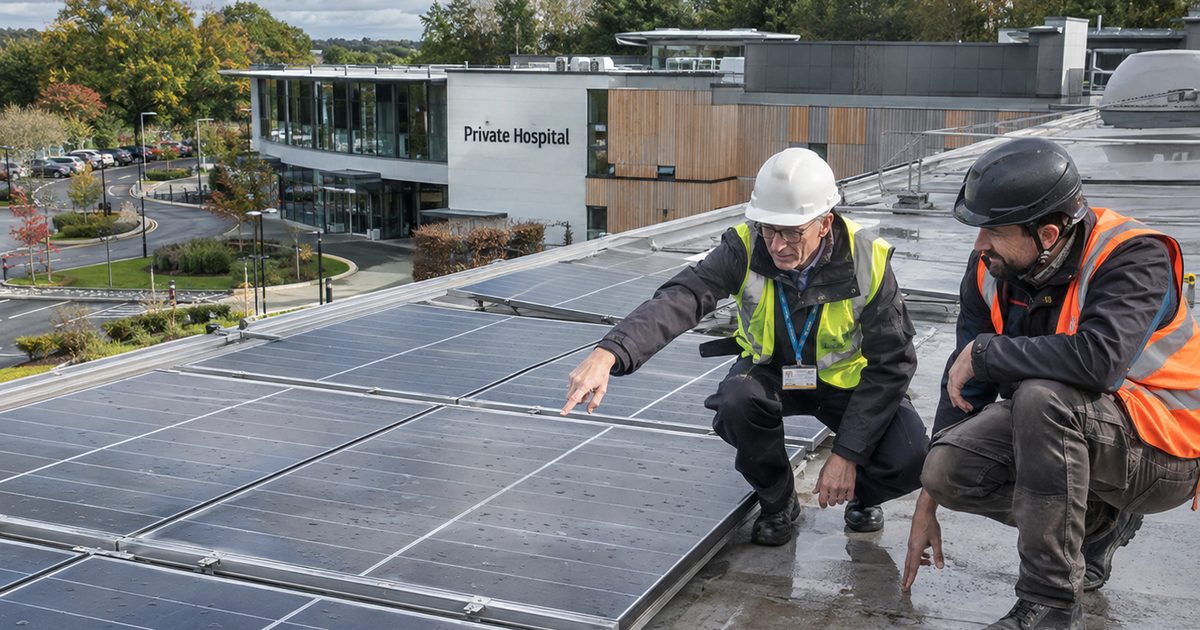
Almost every hospital solar system needs approval from the local distribution network operator (DNO) under G99, and that is usually the longest step. Rooftop solar on non-domestic buildings in England is generally permitted development, but listed buildings, conservation areas and car park canopies need more care. Hospital sites add their own checks: glint and glare near helipads, infection control during works, and how the inverters behave when the site runs on its generators.
The grid connection: G99
Systems above 50 kW three-phase need a full G99 application, a network study and a formal connection offer before they're installed. Smaller commercial systems use a shorter G99 form, and only domestic-scale systems can install first and notify afterwards under G98.1 Larger systems are grouped by size, with Type A covering over 50 kW up to 1 MW and Type B from 1 MW to under 10 MW, and testing and paperwork grow with size.1
Allow around 12 weeks for a typical rooftop application to reach an offer, longer where the local network is constrained. Since 2025 the queue for larger connections has been reordered on a "first ready and needed, first connected" basis, so a complete, well-evidenced application matters more.3
Export limits are cheap for hospitals. If the network can't take full export, the DNO may offer a connection with an export limit, enforced by a control system. A 24-hour hospital exports little of a well-sized system's output, so a limit usually costs very little and can get a quicker, cheaper offer. Your half-hourly data shows how much you'd export at each size; see sizing solar from half-hourly data.
Planning permission
In England, since December 2023, rooftop solar on non-domestic buildings has been permitted development with no capacity limit. Solar canopies over non-domestic car parks have their own permitted development right, up to 4 metres high and at least 10 metres from homes, but need prior approval from the council before work starts.2
- Listed buildings still need listed building consent. Many older hospital and asylum-era sites have listed blocks, so map them before choosing roofs.
- Conservation areas and Article 4 directions can remove or limit permitted development.
- Ground-mounted arrays on spare land usually need full planning permission.
- Scotland and Wales have their own rules. Speak to the planning authority early wherever you are.
Checks specific to hospital sites
| Issue | What to do |
|---|---|
| Helipads | Commission a glint and glare assessment for any array near the landing site or its approach paths. |
| Works near clinical areas | Agree access routes, crane lifts, noise and dust controls with the clinical teams, and carry out an infection prevention and control risk assessment for the works. |
| Standby generators and essential supplies | Under G99, inverters disconnect when the grid is lost. If the array feeds a switchboard the generators back up, the designer must make sure it behaves correctly when the site runs on generators, including during the monthly test. |
| Fire safety | Involve your fire safety adviser and insurer early. Rooftop systems are expected to follow recognised fire guidance, with isolation and cable routing designed in. |
| Roof condition | Get a structural survey, check remaining roof life, and look for asbestos and fragile rooflights, all common on older NHS buildings. |
| PFI buildings | The project company's consent is needed for works on a PFI building, and the contract may need a variation. Start that conversation first. |
A realistic timeline
A straightforward rooftop project typically takes five to seven months from first estimate to switch-on: about a month for feasibility, two months for survey and design, the DNO application running alongside for about three months, then contract, installation and commissioning. On a hospital, add time for the checks above, for procurement through an approved route, and for any PFI variation. Car park canopies and ground mounts that need planning take longer.
Sources
Questions people ask
Do we need planning permission for solar on a hospital roof?
In England, usually not, because rooftop solar on non-domestic buildings is permitted development. Listed buildings, sites with an Article 4 direction and some protected areas are exceptions, and the rules differ in Scotland and Wales.
Do solar car park canopies need planning permission?
In England they can be permitted development, within limits on height and distance from homes, but you need the council's prior approval before starting.
How long does a DNO connection take?
Allow around 12 weeks for a typical rooftop application to reach an offer, and longer where the network is constrained or reinforcement is needed.
What happens to the solar when the hospital is on generators?
G99 protection disconnects the inverters when the grid supply is lost. How the array behaves on a generator-backed switchboard is a design question to settle with your electrical engineer.