Solar payback is the number of years until the savings equal the installed cost. On a 24-hour hospital it's usually helped by a high share of output used on site, and held back by lower unit prices on large supply contracts, costly car park canopies and roofs that need work first. Run your own site through the solar calculator with the share used on site measured from your half-hourly data, rather than relying on a typical figure.
What payback does and doesn't tell you
The calculator reports simple payback: the year when cumulative savings pass the installed cost, without discounting.1 It's a fair first filter for a capital bid, but it ignores the 15 to 20 years of savings after break-even, which is where most of a solar system's value sits. For comparing solar with other uses of the same capital, look at the 25-year net benefit the calculator also shows.1
If a funder pays for the system under a power purchase agreement (PPA), there's no payback at all, because you spend no capital. You compare the PPA rate with what you'd otherwise pay per unit. See paying for solar.
What decides payback on a healthcare site
| Factor | What's different on hospitals |
|---|---|
| Share used on site | Usually high, because wards and plant run through every sunny afternoon and weekend. Our made-up community hospital uses 99.8% of a 299 kWp system's output. Health centres closed at weekends use less. |
| Unit price | Large hospitals often buy at lower unit rates than small businesses, so each kWh saved is worth a little less. Use your real all-in unit rate, not a headline figure. |
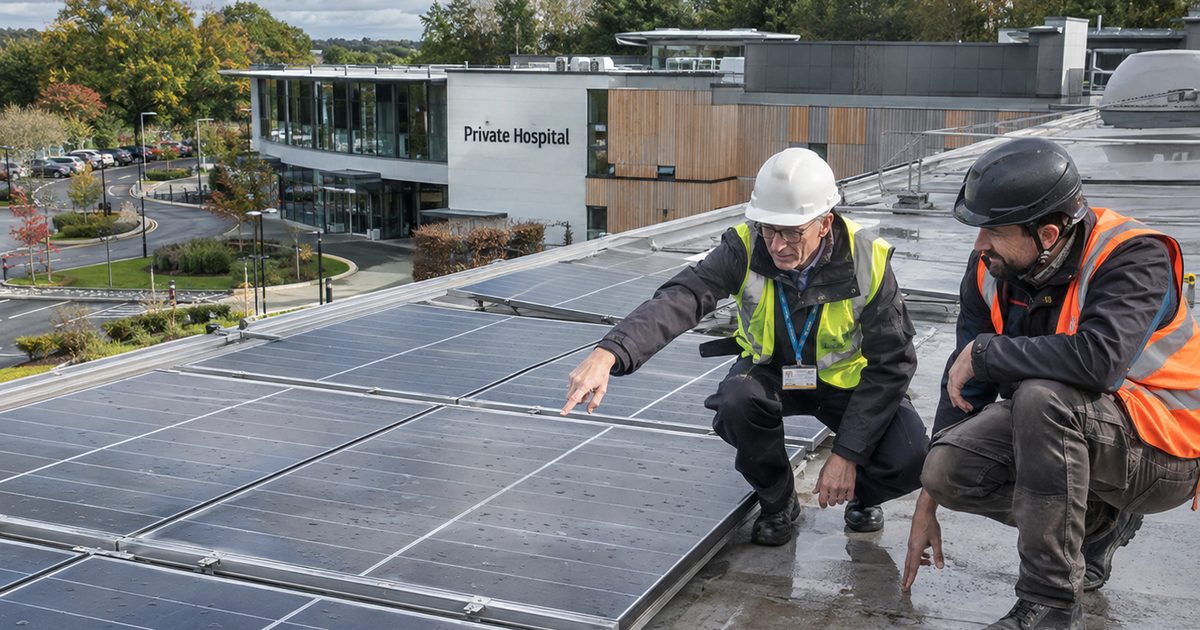
| Mounting | Flat roofs crowded with plant, flues and walkways fit fewer panels. Car park canopies add space but cost more per kWp because of the steelwork. |
| CHP | While a gas CHP engine covers part of the load, solar replaces less grid import. When the engine goes, there's more import to replace. Model the site you'll have. |
| Roof condition | If a roof needs replacing within ten years, do it first. Lifting and refitting panels later costs money and time. Roofs feature heavily in NHS backlog maintenance reported through ERIC.4 |
| Location | Southern England generates more per kWp than Scotland, so the same system pays back sooner in the south.1 |
What the calculator's payback includes
The figure covers the installed cost, savings on electricity used on site, export income at 5p/kWh, electricity prices rising 3% a year, panel output falling 1% in year one and 0.4% a year after, one inverter replacement in year 13, and running costs for maintenance, monitoring and insurance rising with inflation.1 It doesn't include roof repairs, structural work, any DNO reinforcement charge, finance costs or your own staff time. Those come from a survey and the DNO offer.
NHS bodies and private hospitals are different
- Business rates. Hospitals pay business rates, and in England plant used for on-site renewable generation, and batteries used with it, has been exempt from April 2022.2 Solar shouldn't add to your rates bill.
- Tax relief. NHS bodies don't pay corporation tax, so capital allowances don't help them. Independent hospital groups that do can claim allowances on solar, which is special rate plant.3 Check the position with your tax adviser.
- VAT. How much VAT can be recovered differs between NHS bodies and private companies. Ask your finance team before comparing a purchase with a PPA, because it changes the capital cost.
How to shorten payback
- Measure the share used on site from half-hourly data instead of assuming it. On a 24-hour site the measured figure is often higher than the default.
- Size to what you'll use. A system the site uses entirely usually pays back faster than a bigger one that exports at weekends.
- Put the panels on sound roofs first, and car park canopies where roofs run out or need replacing.
- Combine projects. Doing solar alongside a roof replacement or LED upgrade shares access, scaffolding and design costs.
- Check funding first. A grant or a PPA changes the capital cost, and with it the payback. See funding for healthcare decarbonisation.
Sources
Questions people ask
How long does solar take to pay back on a hospital?
It depends on the site, but a 24-hour hospital that uses nearly all its output usually does better than an office of the same size. Measure the share used on site from half-hourly data and run the figures in the solar calculator for your roof, region and unit price.
Does an NHS trust get tax relief on solar?
No. NHS bodies do not pay corporation tax, so capital allowances do not apply. Independent hospital companies can usually claim them.
Will solar increase our business rates?
Not in England. On-site renewable generation, and batteries used with it, are exempt from business rates from April 2022 under SI 2022/405.
Does a battery shorten payback?
Rarely on a 24-hour hospital, which already uses most of its solar. A battery adds cost, so it usually lengthens payback unless the array is large enough to export a lot at weekends.