Hospital heat is usually decarbonised in stages: cut demand, lower the temperatures the heating system runs at, add heat pumps for the base of the heat load, recover waste heat from cooling and ventilation, and keep existing boilers for peaks and resilience until they can be retired. Steam and hot water need separate solutions. Every stage adds electrical load, so check headroom early.
Start with a heat decarbonisation plan
A heat decarbonisation plan sets out how an organisation will replace fossil fuel heating with low carbon alternatives, building by building. Salix's guidance for public sector plans asks for a whole building approach, and includes a section on whether the electricity supply can support a switch to electric heating.1 A plan written now, while there is less grant money about, is still the document funders, boards and contractors ask for first.
Flow temperatures decide almost everything

Many hospital heating systems were designed for boilers running at around 80°C. Heat pumps are most efficient at much lower temperatures, so the questions are how far you can lower the flow temperature, and what has to change to do it. Common steps are:
- balancing the system and fixing controls, so it is not overheating some areas to reach others
- improving insulation and glazing in the worst buildings first
- adding or replacing emitters in areas that cannot be kept warm at lower temperatures
- splitting high-temperature users onto their own supply
New healthcare buildings in England must follow the NHS Net Zero Building Standard, which pushes towards all-electric, low-temperature systems from the start.3
Steam, hot water and other special cases
- Steam. Older estates still distribute steam for sterilisation, humidification and kitchens. Moving to local electric steam generators at the point of use can remove long, lossy steam mains.
- Domestic hot water. Hot water in healthcare buildings is stored and circulated at high temperatures to control Legionella, under HTM 04-01. Heat pumps can pre-heat it, but it normally needs a top-up stage, and the design must keep water safety first.
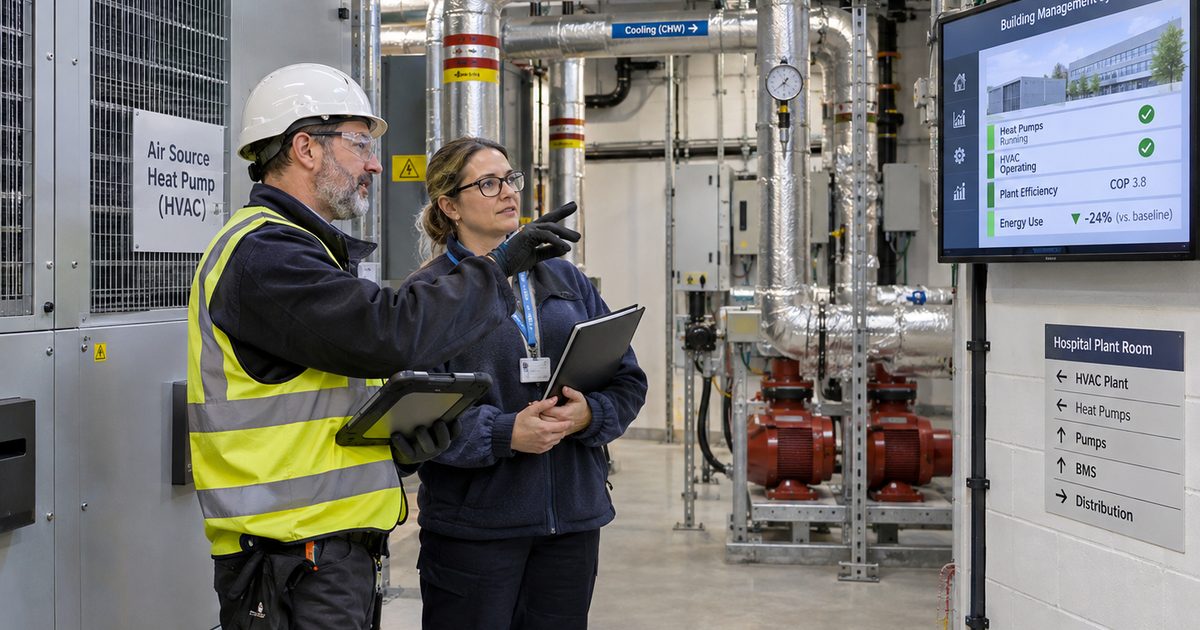
- Simultaneous heating and cooling. Hospitals cool imaging, IT and theatres while heating wards. A water-source heat pump can take heat from the chilled water system and use it for heating. At Nottingham City Hospital, a 160 kW heat pump recovers waste heat as part of a £34.8 million programme that also added air source heat pumps, solar and a site-wide LED upgrade.5
What it looks like in practice
At Bridlington Hospital, 20-year-old gas boilers and a gas CHP unit supplied the heating and hot water. The project decommissioned the CHP, removed a boiler and installed a 600 kW air source heat pump system sized to meet all of the hospital's heating and hot water demand, alongside a 750 kWp solar system.4 In Scotland, renewable heat for all NHS-owned buildings by 2038 means every board is planning work of this kind.2
Heat networks
In England, heat network zoning will identify areas where heat networks are expected to be the lowest-cost low carbon heat, and certain buildings in a zone may be required to connect within set timescales. Large public buildings such as hospitals are typical anchor loads.6 If your site is in a likely zone, a connection may be part of your plan, and your own energy centre may become a source of heat for others.
The electrical side
A heat pump's electrical input is roughly its heat output divided by its efficiency at that moment. On a cold day, a scheme delivering 1 MW of heat at an efficiency of 2.5 draws about 400 kW of electricity, around 420 kVA at a power factor of 0.95. That load arrives in the weeks when the site's electrical demand is already at its highest. Load your half-hourly data into the analyser, enter the agreed supply capacity, and use the headroom check to test a constant extra load. See electrical capacity.
When comparing options, the Phase 4 PSDS cap of £510 of grant per tonne of CO₂e saved over a project's life is a useful yardstick for value.7
Sources
Checked 18 November 2026.
- Salix Finance: Guidance on the preparation of heat decarbonisation plans (Phase 4 Low Carbon Skills Fund)
- Scottish Government: NHS Scotland climate emergency and sustainability strategy 2022 to 2026 (sustainable buildings and land)
- NHS England: NHS Net Zero Building Standard
- Renewable Energy Installer: Bridlington Hospital heat pump and solar project
- Building Better Healthcare: UK's last coal-heated hospital switches to clean energy after £34.8m overhaul
- Department for Energy Security and Net Zero: Heat network zoning, overview of proposals (January 2026)
- Salix Finance: Phase 4 Public Sector Decarbonisation Scheme, project criteria
Questions people ask
Can a heat pump heat a whole hospital?
Sometimes. Bridlington Hospital installed a 600 kW air source heat pump system sized for all its heating and hot water. On larger acute sites, heat pumps more often cover the base load first, with existing boilers kept for peaks and resilience.
Why do flow temperatures matter?
Heat pumps get more efficient as the temperature they have to produce falls. Lowering the heating system temperature, by fixing controls, insulating and upgrading emitters, cuts running costs and the electrical load.
How much electricity will heat pumps need?
Roughly the heat output divided by the efficiency. As an illustration, 1 MW of heat at an efficiency of 2.5 needs about 400 kW of electricity, in the coldest weeks when demand is already highest.