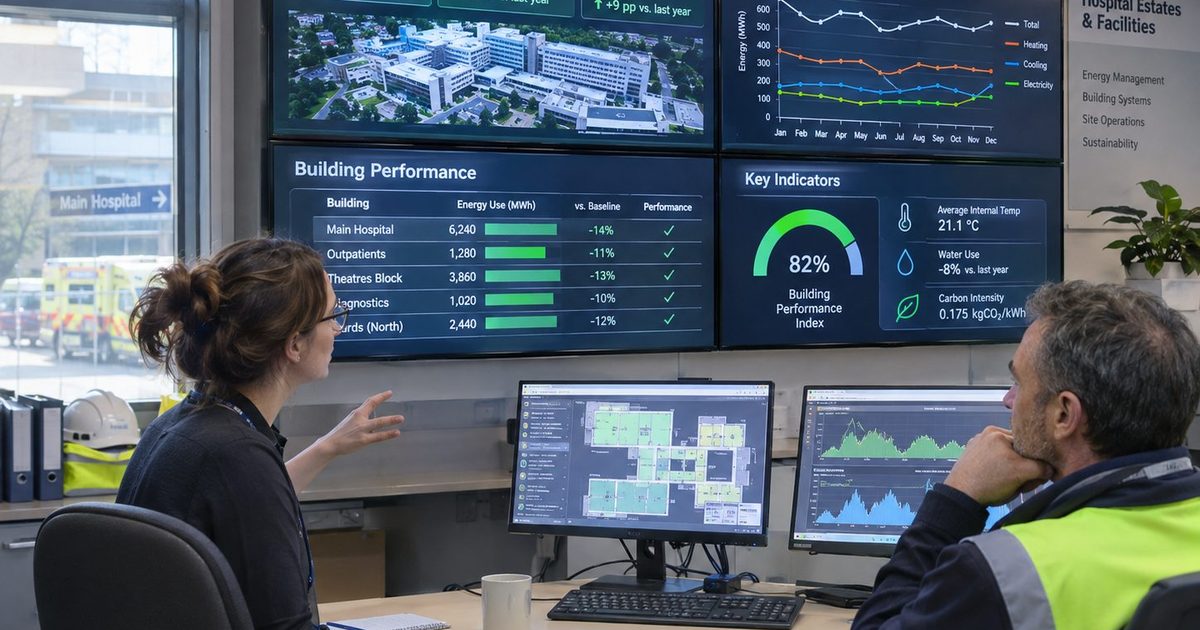
For each main electricity meter, ask your supplier (or whoever manages your energy contract) for 12 months of half-hourly consumption in kWh, one file per meter, as Excel or CSV. If your estates team runs an energy monitoring or BMS system, it may already hold the same data and be quicker to export. On PFI hospitals, ask the project company or its facilities management provider.
Who holds it in a healthcare organisation
| Who | What they usually have |
|---|---|
| The electricity supplier | Settlement data for every half-hourly meter, often downloadable from a business portal |
| Your energy or procurement team, or a broker or bureau | Access to the supplier portal, and often a monitoring and targeting system with every meter in it |
| Estates and the BMS | Main and sub-meter data for theatres, energy centres, outpatient blocks and plant rooms |
| A PFI project company or FM provider | On PFI hospitals, often the supply contract and the meter data |
| Landlords such as NHS Property Services or Community Health Partnerships | Data for health centres where the landlord holds the supply |
Many NHS bodies buy electricity through public sector frameworks, so the supplier relationship may sit with a central procurement or energy team rather than estates. Start with whoever pays the bill.
Which meters to ask for
- Every main import meter on each hospital site, including second incomers.
- Generation meters for any CHP engine or solar, so you can see true site demand, not just import.
- Sub-meters for theatres, imaging, energy centres or outpatient wings, if you have them. They make findings much more specific.
- Health centres, clinics and offices with half-hourly meters, which is where out-of-hours savings usually sit.
The MPAN, the 13-digit supply number on the bill, identifies each meter. How to read an MPAN.
What to ask for
Please send half-hourly consumption data (kWh) for the MPANs listed below, from [date] to [date], as one Excel or CSV file per meter, with one row per day and 48 half-hourly columns. Please name each file after the site.
- One file per meter, named after the site. The analyser uses the file name as the site name.
- Twelve months minimum; up to three years shows trends and a before-and-after for past projects.
- kWh per half hour is best. kW works too, and the analyser says which it found.
Download a request letter template (Word), with spaces for your MPANs and dates.
Your right to the data
Since 1 December 2022, business customers with a smart or advanced (AMR) meter, and anyone they nominate, can ask their supplier for up to 12 months of historic smart meter data free of charge, in a machine-readable format. The supplier must reply within 10 working days.1 For supplier-specific routes, see our guides to British Gas, EDF, E.ON Next, npower Business Solutions and TotalEnergies.
Formats the analyser reads
Excel (.xlsx, .xls) or CSV, laid out as one day per row with 48 readings, one day per column, or one timestamped reading per row. Extra columns such as meter references are ignored. If a file can't be read, the analyser says why. To see what a good file looks like, download our example hospital file.
Information governance
Half-hourly electricity data records energy use, not people, so it contains no patient information. The analyser reads files on your own computer and uploads nothing. If your IG team wants the detail, share the privacy notice.
If a site has no half-hourly meter
Ask the supplier whether the meter can be replaced with a smart or advanced meter that records half-hourly. Check whether the BMS or a monitoring system logs the main meter's pulse output. Monthly readings show the seasons, but not the nights, weekends and peaks this analysis depends on.
Questions people ask
Who holds half-hourly data for an NHS hospital?
The electricity supplier, always. Often also the trust's energy or estates team through an automatic monitoring system, the energy broker or bureau, and on PFI sites the project company or its facilities management provider.
How much data should we ask for?
At least 12 months for every main meter, and up to three years if it exists. A full year captures both winter heating and summer cooling peaks.
Is there a charge?
Business customers with a smart or advanced meter can ask for up to 12 months of historic data free of charge. Many suppliers also offer downloads in their online portals.
Does the data contain patient information?
No. It is the electricity used by the site in each half hour, nothing more. The analyser also keeps it on your computer.